
No products in the cart.
Return To Shop← Back to Resource Library
One-Pagers
Setting Valve Lash Cheat Sheet
Quick Summary
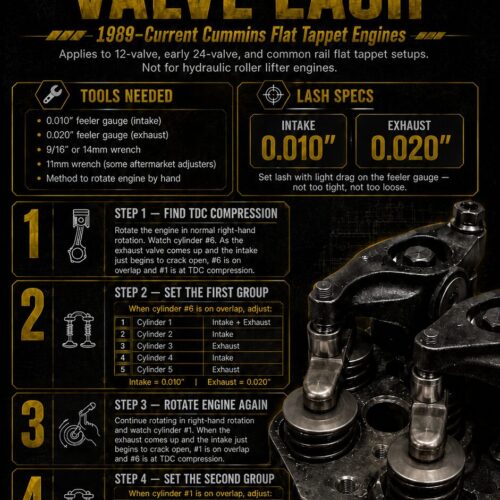
This guide explains how to set valve lash on 1989-current Cummins flat tappet engines, including 12-valve, early 24-valve, and common rail setups. The key point is that lash must be set when the cylinder is at TDC compression, not TDC exhaust/overlap. You first rotate the engine in normal right-hand rotation and watch cylinder #6. When #6 is on overlap, cylinder #1 is at TDC compression, and you set the first group of valves. Then you rotate the engine again and watch cylinder #1. When #1 is on overlap, cylinder #6 is at TDC compression, and you set the second group. The lash specs are: Intake: 0.010" Exhaust: 0.020" The feeler gauge should have light drag — not too tight and not too loose. This procedure does not apply to engines with factory hydraulic roller lifters. Those engines do not require valve lash adjustment.
Read Full Transcript / Details
One of the common questions we get all the time is about setting lash. It seems to be a big issue that we take phone calls on constantly, so we’re going to show you how to do that.
There are different sequences to do this, but this is a 2025-2026 engine. It does not matter if it is your 12-valve, your early 24-valve, or your common rail. The sequence is the same.
There is TDC compression, where both valves are closed and the piston is creating compression. There is also TDC exhaust, which is where the valves are open on the overlap cycle. When you set your lash, you want to set it at the TDC compression mark, and I’ll show you how to find that.
If you watch cylinder #6, you can see the exhaust valve going down. The exhaust valve is going down, then it comes back up. Right as the intake starts to barely crack open, the exhaust is all the way up and the intake just starts to open.
At that point, cylinder #6 is on the overlap cycle, and cylinder #1 has both valves shut. That means cylinder #1 is at TDC compression.
At this point, you’ll come in and make your adjustments. In my case, I’m using an 11mm wrench for the adjustment nut. On factory trucks, it will usually be a 9/16" or 14mm wrench, whichever you have available. You’ll also need a 0.010" feeler gauge for the intake and a 0.020" feeler gauge for the exhaust.
You’re going to start with cylinder #1. Since cylinder #6 is on overlap, cylinder #1 is at TDC compression. Set the intake on cylinder #1 to 0.010" and the exhaust on cylinder #1 to 0.020".
You do not want these super tight. You want to be able to move the feeler gauge in and out with a little bit of light drag.
Next, go to cylinder #2 and set the intake to 0.010".
Then go to cylinder #3 and set the exhaust to 0.020".
Then go to cylinder #4 and set the intake to 0.010".
Then go to cylinder #5 and set the exhaust to 0.020".
At this point, you’re done with the first group.
Now rotate the engine again in normal right-hand rotation. Everything should be rotated in right-hand rotation.
This time, watch cylinder #1. The exhaust valve will go down, then come back up. When the intake valve just barely starts to crack open, cylinder #1 is now on the overlap cycle. That means cylinder #6 has both valves closed and is at TDC compression.
Now you’ll set cylinder #6. Set the exhaust to 0.020" and the intake to 0.010".
Then go to cylinder #5 and set the intake to 0.010".
Then go to cylinder #4 and set the exhaust to 0.020".
Then go to cylinder #3 and set the intake to 0.010".
Then go to cylinder #2 and set the exhaust to 0.020".
Leave cylinder #1 alone because it was already adjusted during the first group.
That is the valve lash procedure for 1989-current Cummins engines with a flat tappet setup.
If your engine still has hydraulic roller lifters, you do not set lash, and this procedure does not apply to you.